Pearson Edexcel · A-Level · Economics B
Course version: 9EB0 · Version from Sept 2015
Accounting ratios: Gross profit margin: (Gross Profit / Revenue) x 100%
Full specification wording
Appendix 4: Accounting ratios: Gross profit margin: (Gross Profit / Revenue) x 100%
The gross profit margin is a crucial profitability ratio that measures the proportion of revenue left over after deducting the direct costs of producing goods or services (cost of sales).
Checked against the Pearson Edexcel 9EB0 specification (opens in a new tab) on .
- Point 1 of 3
- 2 key terms
Study notes
From the checked teaching notes for this specification point.
The idea
The gross profit margin is a crucial profitability ratio that measures the proportion of revenue left over after deducting the direct costs of producing goods or services (cost of sales). It is calculated using the formula: (Gross Profit / Revenue) x 100%. For example, if a business generates £500,000 in revenue and has a gross profit of £200,000, the gross profit margin is (200,000 / 500,000) x 100% = 40%. This indicates that for every £1 of revenue, the business retains 40p as gross profit to cover operating expenses and generate net profit. Analysing this margin helps assess a firm's pricing strategy and production efficiency, allowing comparisons with competitors or historical performance to identify trends in cost control.
What earns the marks
- Identify the correct formula for gross profit margin as (Gross Profit / Revenue) x 100%.
- Calculate gross profit by subtracting the cost of sales from total revenue before applying the margin formula.
- Express the final result as a percentage rather than a decimal or absolute currency value.
- Interpret a higher gross profit margin as an indicator of better production efficiency or greater pricing power.
Common mistakes and how to put them right
Calculating the margin using operating profit or profit for the year instead of gross profit.
Put it right: Ensure only gross profit (revenue minus cost of sales) is used in the numerator.
Forgetting to multiply the final fraction by 100 to convert it into a percentage.
Put it right: Multiply the result of (Gross Profit / Revenue) by 100 and append the percentage sign.
Confusing revenue with profit when selecting the denominator for the calculation.
Put it right: Place total sales revenue as the denominator, representing the total income generated before any costs are deducted.
Exam tips
- Write down the full formula (Gross Profit / Revenue) x 100% before substituting any numbers to avoid placing figures in the wrong position.
- If gross profit is not provided directly, calculate it first by subtracting the cost of sales from revenue.
- Double-check that your final answer is formatted as a percentage, as multiple-choice options may include the decimal equivalent as a distractor.
Try the lesson
The start of the Appendix 4: Accounting ratios: Gross profit margin: (Gross Profit / Revenue) x 100% lesson, made from checked teaching notes for this specification point.
Have a go first
A retail business generates a total sales revenue of £500,000 in a financial year. Its gross profit for the same period is £150,000. What is the gross profit margin for the business?
Listen
The gross profit margin is a crucial profitability ratio that measures the proportion of revenue left over after deducting the direct costs of producing goods or services (cost of sales). It is calculated using the formula: (Gross Profit / Revenue) x 100%. For example, if a business generates £500,000 in revenue and has a gross profit of £200,000, the gross profit margin is (200,000 / 500,000) x 100% = 40%. This indicates that for every £1 of revenue, the business retains 40p as gross profit to cover operating expenses and generate net profit. Analysing this margin helps assess a firm's pricing strategy and production efficiency, allowing comparisons with competitors or historical performance to identify trends in cost control. A strong answer earns marks for these points. Identify the correct formula for gross profit margin as (Gross Profit / Revenue) x 100%. Calculate gross profit by subtracting the cost of sales from total revenue before applying the margin formula. Express the final result as a percentage rather than a decimal or absolute currency value. Interpret a higher gross profit margin as an indicator of better production efficiency or greater pricing power. A common slip: Calculating the margin using operating profit or profit for the year instead of gross profit. Instead, Ensure only gross profit (revenue minus cost of sales) is used in the numerator. Exam tip: Write down the full formula (Gross Profit / Revenue) x 100% before substituting any numbers to avoid placing figures in the wrong position.
See it
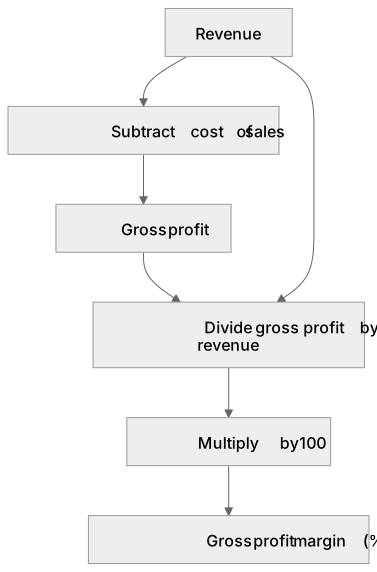
Key words
Say what each word means before you turn the card.
Gross profit margin
Try answering aloud or in your head before turning the card.
Profitability ratios
Try answering aloud or in your head before turning the card.
See every definition
- Gross profit margin
- A profitability ratio measuring the proportion of revenue left over after deducting the direct costs of producing goods or services, calculated as (Gross Profit / Revenue) x 100%.
- Profitability ratios
- A category of ratio that includes the gross profit margin, which measures the proportion of revenue left after deducting the direct costs of producing goods or services.
Label the diagram
Some boxes have lost their names. Pick the right name for each number.
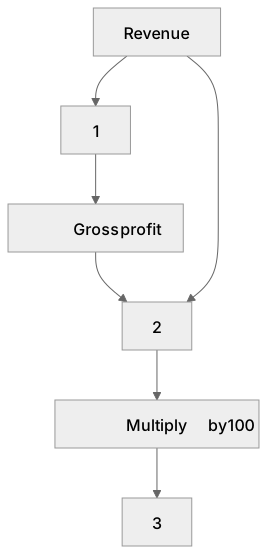
1Box 1
2Box 2
3Box 3
There is more to this lesson
The full lesson goes on to check your understanding and help you earn the marks. Create a free account to carry on, with your progress saved.
A week of Premium from your first lesson · Then the free plan continues · No card, no charge
Test your understanding of Appendix 4: Accounting ratios: Gross profit margin: (Gross Profit / Revenue) x 100%
Active recall beats re-reading. Take an instant quiz now to test what you’ve learned and lock it into long-term memory.
A week of Premium from your first lesson · Then the free plan continues · No card, no charge